
Interview with Mario Tauchi
We must do the best we can. Life is never fair, but your reality is far too unfair. You have done nothing wrong. Please forgive us for being powerless.

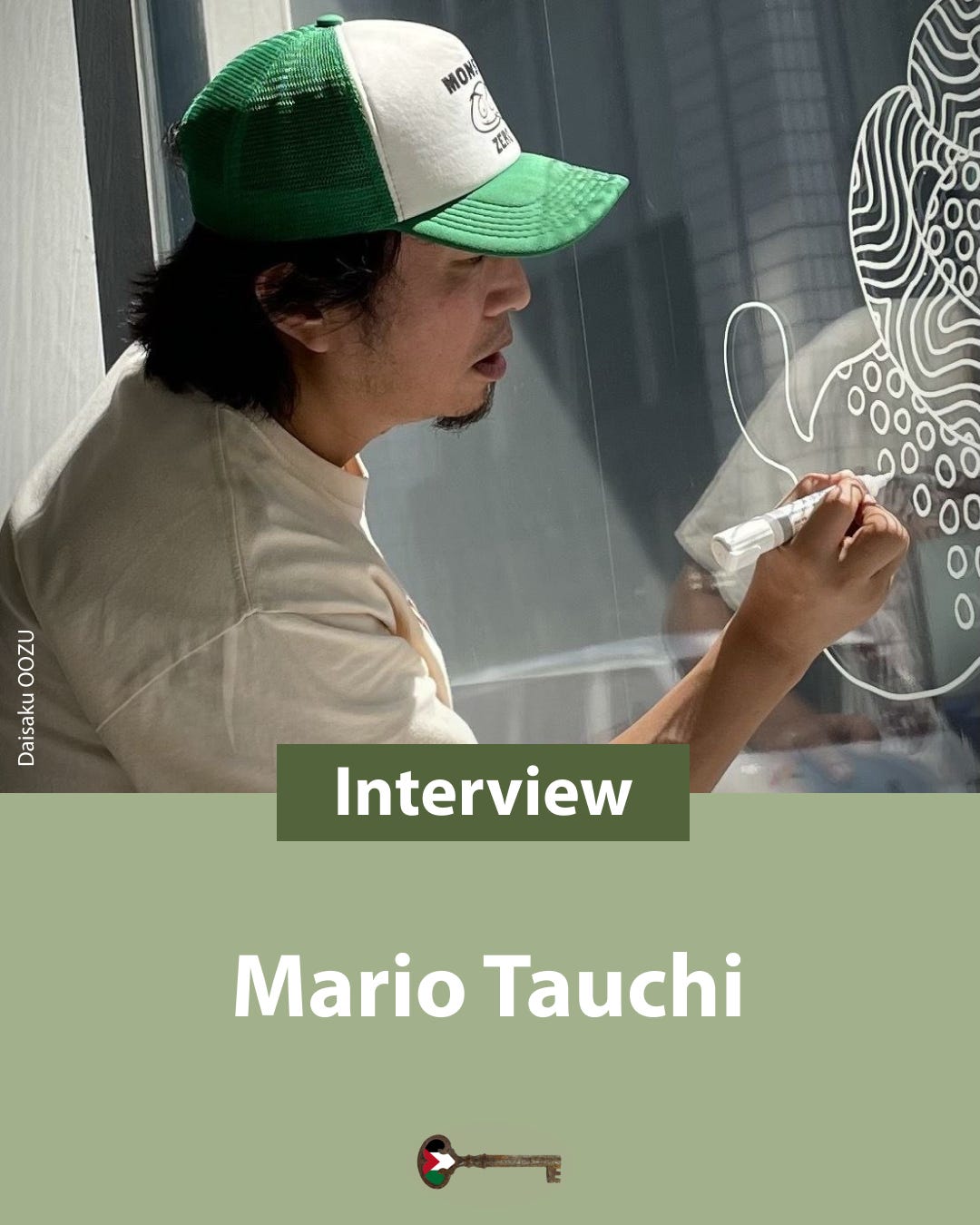
We had an interview with Mario Tauchi.
Tauchi is a Japanese artist based in Tokyo. In addition to creating art, he works in publishing as a translator and a writer. He started creating art in 2001, when he was 28 year old. Mario also works as a performance artist, and has performed in London, Amsterdam, Frankfurt, Hong Kong, and in various parts of Japan. He often collaborates with musicians, poets and other performance artists.
1. You've drawn beautiful and impactful artworks about Gaza. What was your goal with these drawings, and how did the ideas for them come to you?
As you can see, I have been drawing one small sketch every day based on the photos and videos coming out from Gaza. The scenes vary, but what each of the drawings have in common is the message “STOP GENOCIDE.” In other words, that is the goal I am seeking – just end the genocide.
I drew the first piece on October 8, 2024, exactly one year after the current genocide began (of course, it all goes back to 1948, at least). After following the news for so long, I could no longer tolerate the situation where such horrific, terrible, inhuman violence was being perpetrated in plain sight. I felt compelled to take some action.
2. In your opinion, which of your drawings is the most impactful?
For me, there isn’t one single drawing that carries more meaning than the others. I draw in response to the situation as it changes and escalates in brutality, day by day. Each drawing has a date, and that date itself functions as a device to visualize the passage of time and the events unfolding with it. These drawings are records, testimonies, and at the same time, protests against what has been happening.
3. What do the Japanese think about Gaza? And are they aware of the realities of this war?
There are certainly people in Japan who follow the news closely and even carry out their own protests. In the past two years, quite a few books have been published about the current situation in Palestine and the history that has led to it. Unfortunately, however, many people show what I would call a typically Japanese response: pretending not to see what they already know. And there are, surprisingly, also many who are simply unaware of what is happening right now.
The coverage in Japan’s mainstream media is far from sufficient. That is one reason I continue to draw and share on social media. Actual photos and videos can be visually and psychologically overwhelming, causing people to look away. But when the same reality is translated into primitive monochrome drawings, some people may stop, look, and begin to take notice of what is going on.
4. Tell us about Yusuke Furusawa’s solo protest. What do you think of his valuable work?
After the ceasefire agreement was reached in January 2025, for a time, I stopped drawing. To be honest, I felt a certain relief that I could finally pause. But even then, Yusuke Furusawa continued his solo protest, standing on the streets of Tokyo every single day. He deeply understands the essence of things. Even after the ceasefire was broken, I still could not resume my drawing. One day, walking through Shibuya with a heavy heart, I heard Yusuke Furusawa’s strong voice. I introduced myself and we exchanged a few words. In that moment, I felt that I, too, must continue my protest.
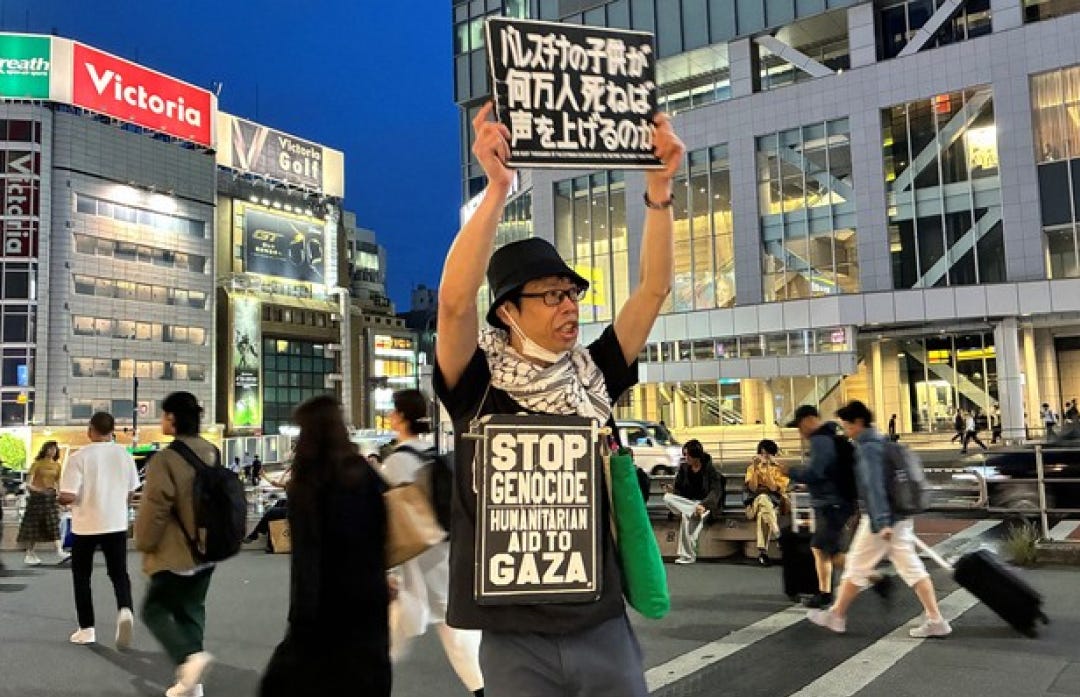
Photo credit: Mainichi/Kohei Chiwaki
Yusuke Furusawa is a talented actor with a solid career in Japan. He has taken on distinctive roles in avant-garde theater as well as in commercial television and film. As you can imagine, for someone in such a field, openly raising his political voice comes with real costs. I believe he is continuing his protest at the expense of his acting career. I have nothing but respect for him. He is showing us a clear sense of priorities.
5. If you could send a message to a child in Gaza, what would you say?
I want you to survive, and to experience other kinds of life. For that, we must do the best we can. Life is never fair, but your reality is far too unfair. You have done nothing wrong. Please forgive us for being powerless.