
Interview with Jen Perelman
We must defend progressive voices in office and work to elect diverse voices running for office.

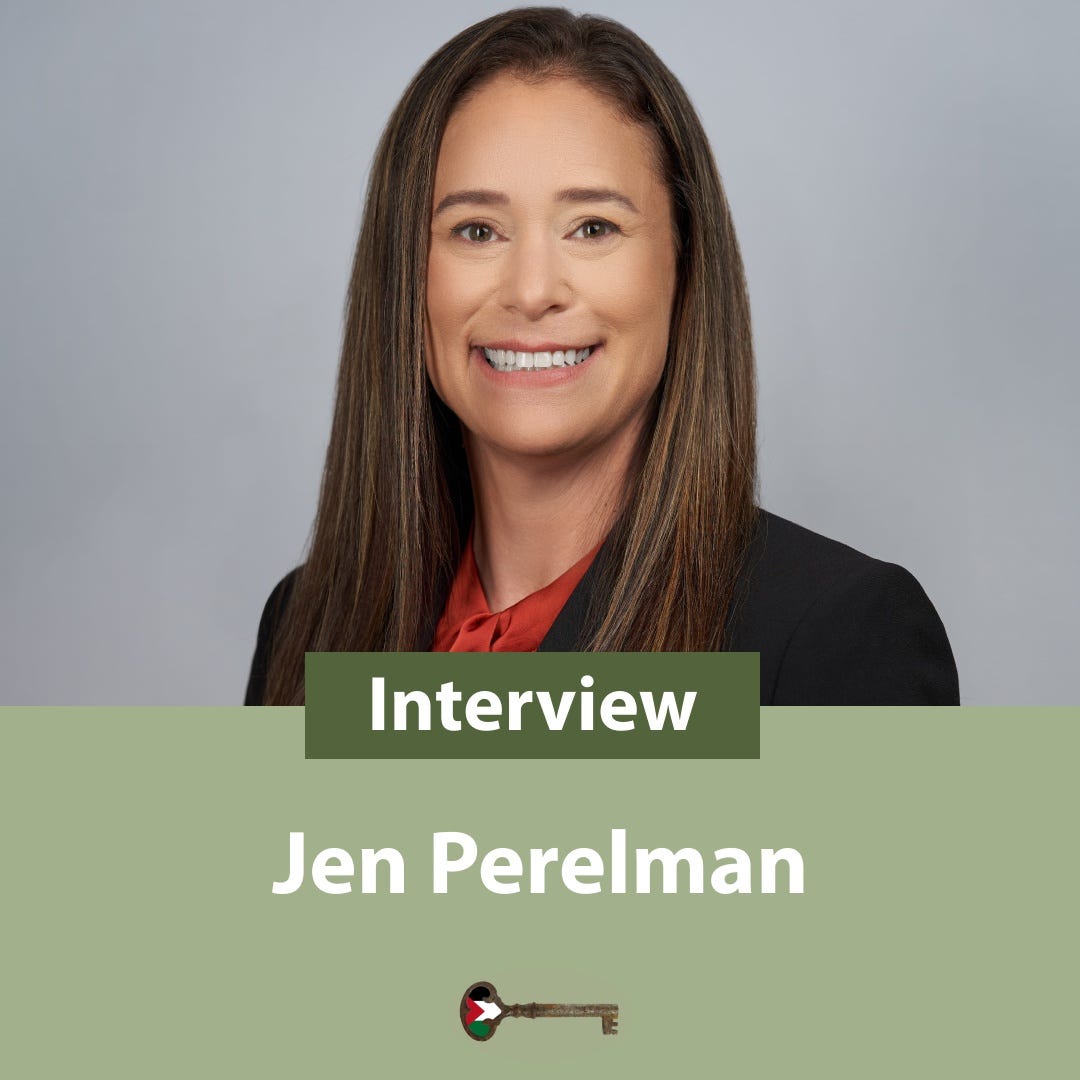
We had an interview with Jen Perelman, the Democratic candidate for Congress (FL-25).
Jen Perelman is a second generation Florida native, born and raised in North Miami Beach. Jen decided to challenge Debbie Wasserman Schultz in 2020. Following the campaign, Jen and her business partner, created the JENerational Change Podcast and YouTube Show. The mission of JENerational Change is “transforming politics into service” by continuing to educate people and build strong coalitions for change.
1- What is the best solution to end the Gaza war?
To end the war in Gaza the US must change its fundamental approach of unconditional support for Israel. For decades we have seen a never-ending flow of military aid to Israel, with almost no oversight. This only perpetuates the conflict. The massive aid packages, like the $38 billion MoU signed in 2016, fuel the violence rather than promoting peace. Congress must cease approving billions in military aid and arms sales, and President Biden should halt vetoes of ceasefire resolutions. It's imperative to hold Israel accountable for any war crimes and to condition aid and adhere to international law and human rights standards. This entails actively working towards a just and lasting resolution of the conflict by supporting diplomatic efforts and prioritizing the rights and well-being of all involved.
In Congress I'm committed to strategically advancing foreign policy initiatives that are in the best interest of our country. Drawing on my experience as a litigator, I'll craft legislation, introduce appropriations bills or amendments, and navigate committee proceedings with precision and persuasion. I am determined to secure appointments in relevant committees to shape the legislative process to align with our policy objectives. I will promote stability, security, and prosperity, both domestically and internationally - and all nation states that are in violation of international law should be held accountable. As a representative, I would propose and support the use of sanctions, boycotts, embargos, and all diplomatic forms of political pressure to force rogue nations into compliance with international law and principles of human rights.
2- Considering the 67% of the people support for the ceasefire, how could the media and people convince the politicians against the ceasefire to admit it?
Pressure is key, and it's happening now. Across university campuses and cities nationwide, there are diverse coalitions mobilizing in protests. We refuse to be complicit in the war crimes and genocide occurring in Gaza by Israel with the unwavering support of our government. Not in our name or with our money. This collective action demonstrates how we can build pressure on politicians to acknowledge the need for a ceasefire.
Since media coverage began on October 7th, 2023, we've observed a shift in how the crisis is reported, indicating a growing awareness and momentum behind the call for action. Additionally, when the initial resolution HR 786 was drafted by Rep. Cori Bush, it only had 18 co-sponsors. Now, we're up to over 100 members of the House and Senate who have called for a ceasefire. Major metros and small cities have drafted and passed ceasefire resolutions at their city councils. This progress, though slow, signifies a growing recognition of the urgency for peace.
3- What is the solution to fight against anti-Semitism and Islamophobia in the society?
To combat anti-Semitism and Islamophobia, we must champion inclusive values that promote civil rights, diversity, and freedom of religion. This entails opposing discriminatory policies that restrict rights or enable profiling based on religious or ethnic identity. We must recognize that "liberty and justice for all" is frequently used as a slogan, rather than a reality, particularly when state representatives and our federal government is only worried about protecting one group while vilifying the other.
At every level of government, We need to reassess our approach on both domestic and foreign policy to ensure fairness and compassion guide our policies. Policies that prioritize human rights and socio-economic justice can help foster global stability and lessen the tensions that are rooted in religious or cultural differences. By working with these principles as our core values, we can build a more tolerant and inclusive society where all individuals, no matter what their background, are respected and valued.
4- AIPAC plans to spend $100M in the election, how to beat AIPAC?
To counter AIPAC's influence, building coalitions like the Reject AIPAC group is crucial. That coalition consists of various organizations engaged in coordinated and uncoordinated grassroots work and media campaigns, serving as a key strategy. However, it's beyond unfair for them to compete against the financial and political power AIPAC wields. Until we overturn Citizens United, this is the reality.
We must defend progressive voices in office and work to elect diverse voices running for office. More importantly, we need you. We need regular people to donate, to sign up to knock on doors, call voters, build a strong ground game, and do their part to amplify the message of underfunded candidates. I encourage everyone to get involved in every election from school boards to U.S. Congress if it can affect your livelihood. Additionally, we must be relentless in pushing for organizations like AIPAC and to register under the Foreign Agents Registration Act (FARA) can help increase transparency and accountability in its lobbying activities.